There has been a shift for healthcare providers on how to maintain electronic health records. By 2017, already two-thirds of health systems and hospitals had adopted cloud-based technology. This industry-wide shift to practice management software has left some wondering how the security of each system compares.
As technology continues to expand, healthcare providers must decide between electronic health records (EHR) and electronic medical records (EMR): server-based or cloud-based EHR systems. In recent years, however, cloud-based EHR has increasingly replaced server-based EHR, with one deciding and yet often abstruse factor being the security of these systems.
Cloud-based and server-based EHR–what’s the difference?
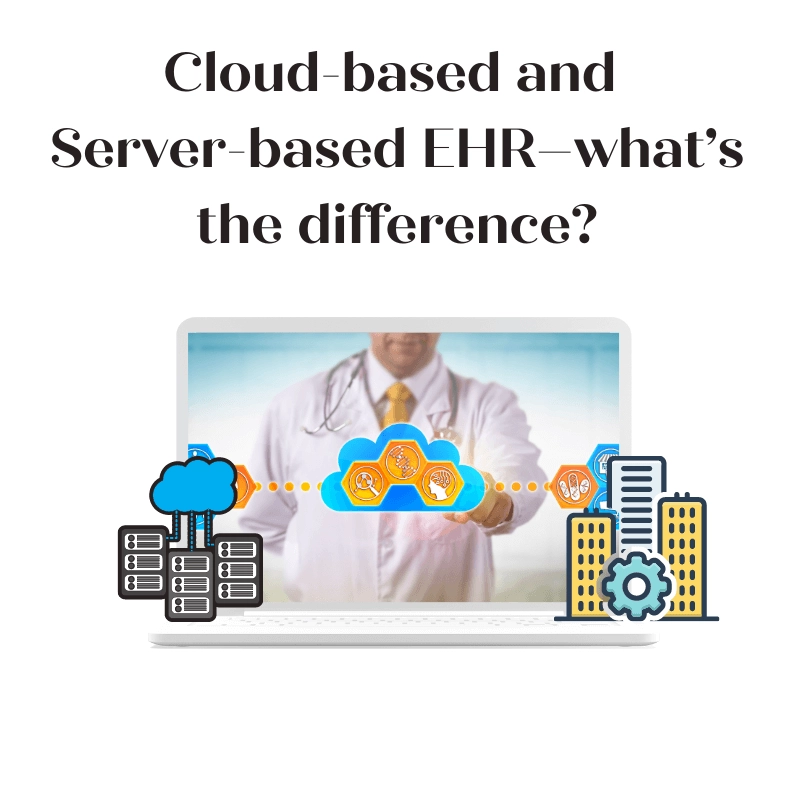
There are two main types of EHR systems: cloud based ehr systems and server based ehr systems for maintaining healthcare records. Cloud-based EHR systems are accessed through the web and are maintained by a third party known as a software-as-a-service (SAAS) provider. Server-based EHR, also known as on-premise, is stored on a server internal to the practice. Cloud-based EHR is accessible on any device that has a secure connection, whereas server-based EHR is accessible solely from devices within the personal server.
Implementing a server-based system requires hardware and software installation and necessitates a local IT department for regular management and upkeep. On the other hand, a cloud-based system requires neither installation nor IT personnel, since it is internet-based, provides live IT support, and automatically updates. Cloud-based systems, therefore, are less expensive, less time-consuming, and require fewer personnel.
The costs associated with server-based EHR come with two primary advantages: (1) non-reliance on internet connectivity, and (2) more control over infrastructure configurations (where and how data is stored).
How should internet reliability factor in?
Reliable access to an EHR plays a critical role in clinical productivity, making internet reliability an important consideration when choosing a system. Practices with highly unstable or nonexistent internet connections may reasonably hesitate to adopt web-based EHRs that depend on consistent connectivity. That said, while cloud-based EHRs do require internet access, they are less prone to the system crashes that can affect server-based solutions. They also reduce risks related to physical security, such as data loss from disasters or theft, and simplify backup and recovery.
Both cloud-based and server-based systems carry some risk of interruption, creating a degree of gray area when evaluating reliability. For the most remote practices with little to no internet access, server-based systems may remain the only viable option for now. Beyond that, the level of internet unreliability that justifies a server-based system depends on practice-specific factors, including access to local IT support and the resources available for infrastructure investment. For most practices, however, cloud-based EHRs offer access that is just as reliable, and is often more reliable than traditional server-based systems.
How do cloud-based systems keep EHR secure?
The HIPAA Omnibus Rule, enacted in 2013, requires cloud-based vendors that store, receive, maintain, or transmit protected health information from health plans, providers, or healthcare clearinghouses to be bound to what's called a "business associate agreement". Through this agreement, the vendor becomes contractually liable for this data's security. Since this update, cloud-based vendors have ramped up sophisticated security controls operated by experts. This includes:
- Physical security at cloud-service provider plants.
- Firewalls establish a barrier between internal and trusted networks and untrusted networks by monitoring incoming and outgoing traffic and filtering traffic based on a set of security rules.
- Intrusion detection systems that monitor activity within the network and analyze it for signs of violations of or threats to the security policy. Intrusion prevention systems use this information to preemptively block malicious remote file inclusions, block the offending IP address, and alert security personnel to the threat.
- Anti-virus software that prevents, scans, detects, and deletes viruses from the system.
- Identity and access management, which verifies that the right users have appropriate access to data.
- Automatic updates that ensure security by continuously staying ahead of potential vulnerabilities through patch maintenance. This feature also makes complying with changing regulations easy, too.
- Data encryption ensures that if a data breach were to occur, it is indecipherable.
These protective measures are in place regardless of the device one uses. For this reason, cloud-based systems are the only viable way to access EHR remotely without compromising security. Server-based systems, on the other hand, are only securely accessible within the server; that is the practice itself. This affords practices with cloud-based systems the flexibility to accommodate remote and virtual healthcare, while maintaining HIPAA-compliance. Post-pandemic, this is a highly advantageous security feature.
Even so, hesitation around allowing a third party to control where and how EHRs are stored is understandable. Patients place their trust in healthcare providers to safeguard sensitive information, and providers are committed to upholding that responsibility. People also tend to perceive risks as lower when they feel those risks are within their control. While this perception doesn't always reflect reality, it's unrealistic to assume every organization can manage security better on its own, and it often shapes decision-making.
In theory, a practice using a server-based system, unconstrained by budget and determined to match the same level of security, could implement many of the same protective measures. In practice, however, doing so is highly impractical and unlikely.
The Bottom Line
Ultimately, cloud-based EHR systems offer the most secure, cost-effective, and technologically efficient approach to managing electronic health records. A server-based system would require a prohibitive investment of time, expertise, and resources, making it an unrealistic expectation for most practices. While practices in remote areas with highly unreliable internet access may need to rely on server-based EHRs for now, cloud-based EHR systems remain the best option for the vast majority of organizations when considering cost, operational efficiency, and security.
While choosing the right infrastructure is a critical first step, selecting the right partner is what truly elevates a practice. Zoobook Systems, the most user-friendly AI-powered EHR on the market, has positioned itself as a leading cloud-based EHR system by going beyond simple data migration to deliver a comprehensive ecosystem tailored to the unique demands of behavioral health and addiction treatment.
Unlike generic platforms, Zoobook integrates advanced AI-powered tools, automated HIPAA-compliant security updates, and a seamless telehealth experience, eliminating the need for costly on-site IT teams. With a strong focus on user-centered design that minimizes administrative burden, Zoobook Systems ensures that moving to the cloud is more than a technical upgrade; it's a strategic decision that empowers clinicians to spend less time on documentation and more time improving patient outcomes. To see how Zoobook can support your practice, schedule a free demo.
Every practice is unique, and it's important for organizations to evaluate their specific needs, resources, and infrastructure to determine whether a cloud-based or server-based EHR is the right fit.